Category Archives: News

UNA closure letter and prayer

Dear members and friends,

We write to let you know that after 31 years of operation the Executive of the Uniting Network Australia has decided to close the organisation as of 31 December 2025. UNA is the last remaining LGBTIQA+ specific support and education in the life of the Uniting Church. The journey started with the formation of Cross Section NSW/ACT in NSW/ACT in March 1982.

For more than 30 years the Uniting Network has been transformative in the life and witness of the Uniting Church across the country. We give thanks to God for the engagement of many LGBTIQA+ people, and allies who have shared their lives, their stories, made space, and encouraged us to look beyond our differences to see the divine imagined in each and every person.

The work of Uniting Network has been pivotal in our growth as a whole people of God. As we bring this chapter of Uniting Network to a close we lay down our burdens acknowledging there have been moments of pain and sorrow across the years which some have borne heavily, these too are part of our story and transformative witness.

We believe that the many members and friends of UNA, and synod groups, have contributed to a greater awareness and acceptance of LGBTIQA+ people in the UCA. There have been changes and for the better, which is not to say that we have achieved all we set out to do many years ago.

There are new beginnings with the establishment of the Uniting Church Assembly Pride Circle as an official group within the life of the Uniting Church to support queer Pride. The Executive is pleased with the composition of the Pride Circle (all queer folk) and have allocated remaining member funds to the ministry of the Pride Circle.

We celebrate all that has been achieved in and through our work and look with hope to the continuing pilgrimage of welcome and inclusion in the life and witness of the Uniting Church to come.
At our final meeting, Executive member, the Revd Vicki Aitken, offered the prayer which follows this letter.

Yours in Christ

(Revd) Amanda Nicholas, Co-Convenor
Warren Talbot, Secretary

Prayer for the closure of UNA

Lord God,

You created us in all our diversity in your image…in the image of your trinitarian personalities. And you declared that all you had made was good. So we finish today’s last ever meeting of the Uniting Network Australia with a sense of celebration and pride for all that have been achieved, all the relationships that have been formed and all the encouragement given and the solidarity experienced.

Thank you Lord for all that the Uniting Network has achieved over it’s 31 years, all those people that were apart of the Uniting Network from the beginning. Those who went before us or with us who carried the torch of social justice passion and who helped make an impact on the UCA and the steps that have been made for LGBTQIA+ inclusion.

We thank you that the Pride Circle has now been established at Assembly and that more might be achieved for our LGBTQIA+ siblings in Christ. So we don’t end in sadness but with hope for the future. As we pass this passion and responsibility on to the Pride Circle we pray that your Holy Spirit would give the Pride Circle advocates and panel wisdom and discernment as they move forward. And that you would give all those past and present executive and members from the Uniting Network your peace that transcends all understanding as they set this work and time to rest.

We ask this in Jesus’ mighty name,
Amen.

Daring 2022 – Speaker Profile

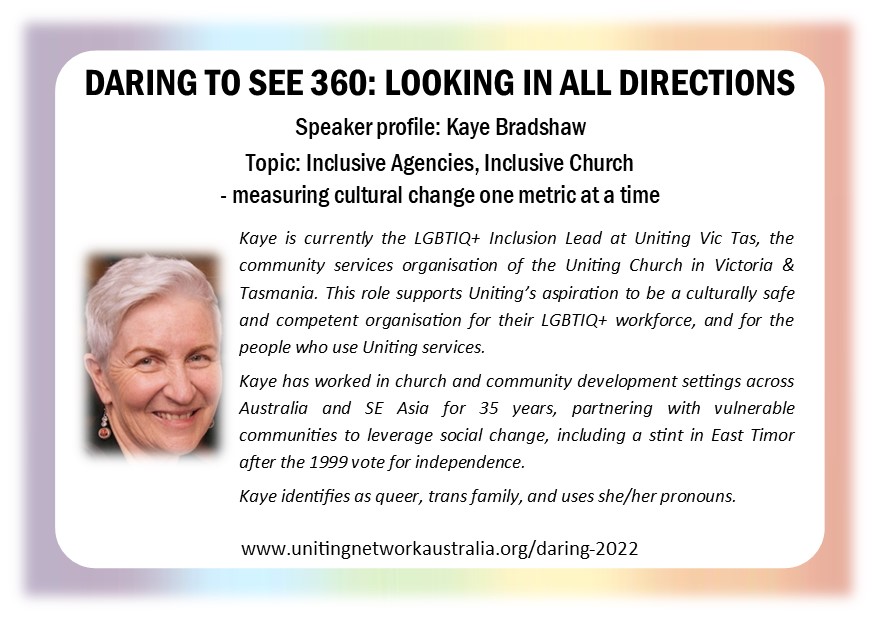
The third speaker to be announced is Kaye Bradshaw on ‘Inclusive Agencies, Inclusive Church – measuring cultural change one metric at a time’. There will be several speakers across the day from different backgrounds.

View some of the work Kaye has been involved with – Uniting: A future we believe in YouTube.

Join us on Saturday 11 June, online or at a local hub. Find out more on the Daring 2022 page and register via TryBooking to be part of the day.

Daring 2022 – Connection, Hubs and Dinner

Hubs

Join us online at home or meet with others at a local hub! More hubs have just been announced across Australia!

Please note: Lunch will not be provided. If you are attending a hub, please bring your own lunch or join some of the others and find lunch nearby.

When you book your ticket, indicate your interest in joining a hub.

*NEW
ACT
Tuggeranong Uniting Church, Comrie Street, Wanniassa
Hub contact: Delia 0438 018 799

*NEW
New South Wales
Neutral Bay Uniting Church, 49a Yeo Street, Neutral Bay – Access is via Barry Street
Hub contact: Alex 0411 566 135

South Australia
Blackwood Uniting Church, 266 Main Road, Blackwood.
Hub contact: Melissa 0404046057

Tasmania
Devonport Uniting Church, 12 Forbes Street, Devonport.
Hub contact: Susan 0438 452 445

Victoria
St Kilda Uniting Church, 163 Chapel Street, St Kilda.
Hub contact: Laura 0474 077 249

Dinner

Whether you attend online or in person, you still have the option of joining the local group for dinner. To help with dinner reservations, please make sure to indicate your possible interest when booking your ticket. Come along and meet like minded folk.

Book your place via TryBooking.

Daring 2022 – Speaker Profile

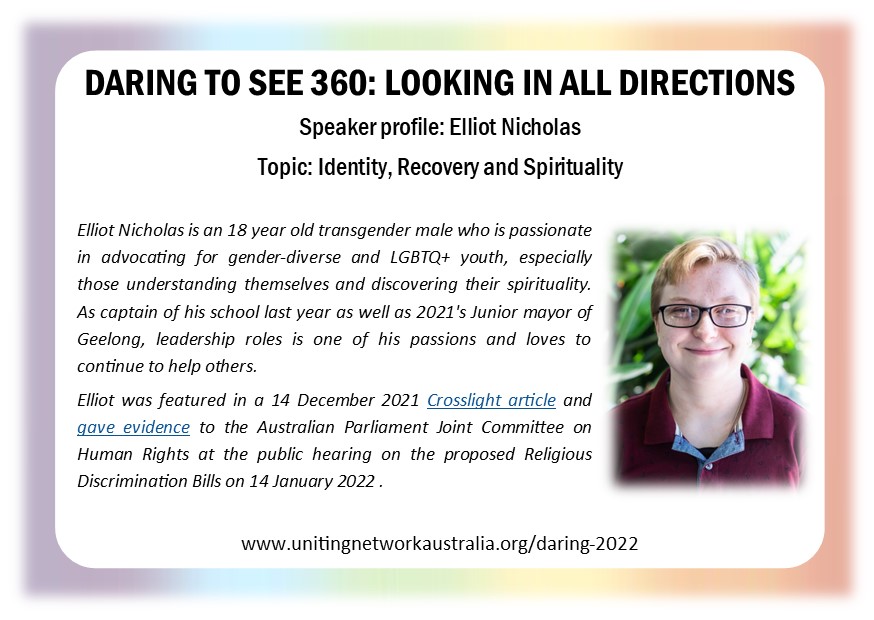
The second speaker to be announced is 18-year old Elliot Nicholas who will be speaking on ‘Identity, Recovery and Spirituality’. There will be several speakers across the day from different backgrounds.

Join us on Saturday 11 June, online or at a local hub. Find out more on the Daring 2022 page and register via TryBooking to be part of the day.

Daring 2022 – Speaker profile

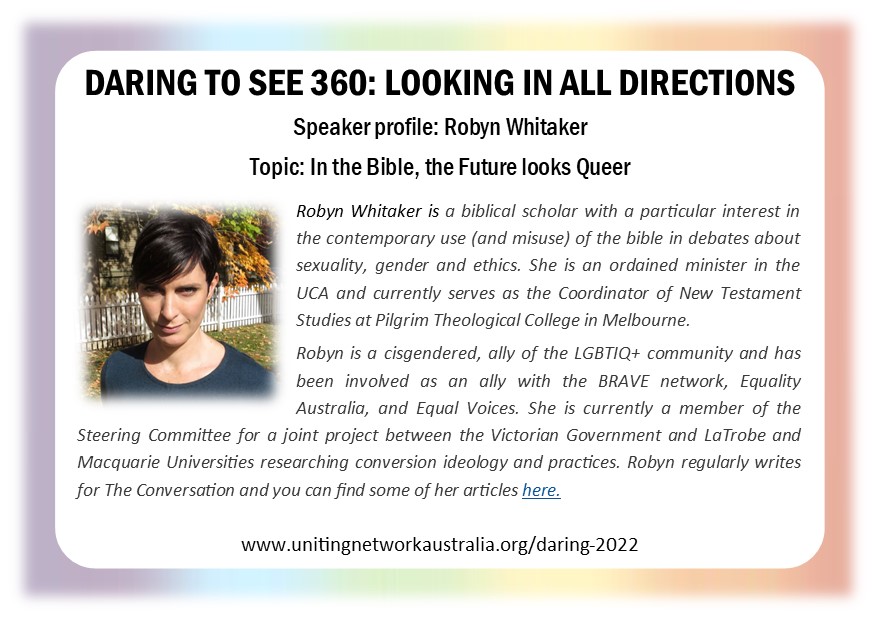
Join us on Saturday 11 June, online or at a local hub, for Daring 2022. Our first Speaker has been announced with Robyn Whitaker presenting on ‘In the Bible, the Future looks Queer’. There will be several speakers across the day from different backgrounds. We look forward to connecting with you!

Find a draft program on the Daring 2022 page and register via TryBooking to be part of the day.

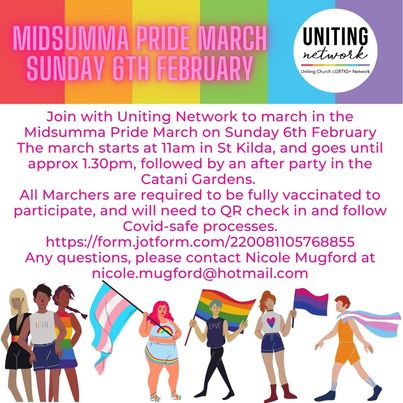
March with us this Midsumma Pride March Sunday 6th Feb

Midsumma Pride March 2022 will return to Fitzroy St, St Kilda on Sunday 6 Feb 2022. Once again marchers will colour Fitzroy St in a parade of solidarity. UNA will march, ensuring COVID-19 safety requirements are upheld, and we’d LOVE you to march with us!

Please register interest for a spot in our Midsumma Pride March group. A position in the march group is ticketed and allows each person into the after party in the Catani Gardens post march. More info will come from Nicole Mugford (UNA Co-convenor) regarding the march group.

Thank you for your ongoing interest and support.

Managing the Uniting Church: Balancing Faith and Financial Responsibility

The Uniting Church plays a pivotal role in communities, offering spiritual guidance, fostering community bonds, and engaging in various outreach programs. Beyond its spiritual mission, the church must navigate the complexities of organizational management and financial stewardship to ensure sustainability and effectiveness in its endeavors. Understanding the legal and tax frameworks is essential for Uniting Church leaders who may engage in ancillary business activities to support their mission.

Defining the Mission of the Uniting Church

At its core, the Uniting Church is dedicated to providing spiritual support, promoting social justice, and fostering a sense of community among its members. Programs typically include worship services, educational workshops, community service initiatives, and support groups. These activities are usually funded through donations, grants, and fundraising events, emphasizing the importance of transparent and responsible financial management.

Organizational Structure

The Uniting Church is generally structured as a nonprofit organization, focusing on its mission rather than profit generation. This structure allows the church to receive tax-exempt status, enabling it to allocate more resources towards its programs and services. The governance of the church typically involves a board of trustees or elders who oversee the operations, ensuring that the church adheres to its mission and complies with relevant laws and regulations.

Financial Management and Stewardship

Effective financial management is crucial for the sustainability of the Uniting Church. This includes budgeting for regular activities, maintaining reserve funds for emergencies, and ensuring that donations are used effectively to further the church’s mission. Transparent accounting practices and regular financial reporting help build trust among congregants and stakeholders, ensuring continued support and engagement.

Engaging in Auxiliary Business Ventures

To support its mission, a Uniting Church may engage in auxiliary business ventures such as running a bookstore, café, or event space. These ventures can provide additional revenue streams, helping to fund church programs and initiatives. When undertaking such business activities, it is essential to establish the appropriate legal structures to manage these operations effectively and protect the church’s assets.

Legal and Tax Considerations

When a Uniting Church decides to operate an auxiliary business, choosing the right business structure is vital. One common option is to form a Limited Liability Company (LLC) to manage the business venture separately from the church’s primary nonprofit status. This separation helps protect the church’s assets from potential liabilities arising from business operations.

For churches based in Mississippi, understanding the mississippi classification of llc tax is critical. This classification determines how the LLC will be taxed and what filings are necessary to comply with state tax laws. For instance, an LLC can be classified as a disregarded entity, partnership, or corporation for tax purposes, each with its own implications for tax reporting and liability. Consulting with a tax professional or legal advisor can help ensure that the LLC is correctly classified and that the church remains compliant with Mississippi tax regulations.

Community Engagement and Outreach

A Uniting Church’s impact extends beyond its immediate congregation through various community engagement and outreach programs. These programs often address local needs such as food insecurity, homelessness, education, and healthcare. By effectively managing both its core activities and any ancillary business ventures, the church can maximize its positive impact on the community.

Addressing Workplace Discrimination in Australia: Legal Protections and the Path to Inclusive Work Environments

Discrimination in the workplace is an issue that affects both individuals and communities, often creating environments that hinder equality, respect, and growth. In Australia, federal and state laws provide protections against workplace discrimination, and organizations increasingly recognize the value of fostering inclusive practices. This article explores the legal rights of employees, common forms of workplace discrimination, and how advocacy for inclusivity can promote respectful workplaces for all.

Understanding Workplace Discrimination in Australia
Discrimination occurs when an individual is treated unfairly due to characteristics like gender, sexual orientation, race, disability, age, or religion. Discrimination can range from exclusion from opportunities to ongoing harassment and hostility. Common forms of discrimination in Australia include:

  • Gender and Sexual Orientation Discrimination: Exclusion from promotions, pay inequities, or biased treatment based on gender identity or sexual orientation.
  • Racial and Ethnic Discrimination: Prejudice or bias based on race or ethnicity, affecting job assignments, promotions, or interpersonal interactions.
  • Age and Disability Discrimination: Unfair treatment in hiring, promotions, or work assignments based on age or physical ability.

Legal Protections for Australian Workers
Australia has comprehensive legal frameworks to address workplace discrimination, including:

  1. Fair Work Act 2009
    The Fair Work Act provides protections against discrimination and ensures that all employees are entitled to a workplace free from bias. This act covers protections from unfair dismissal due to discriminatory factors, offering recourse for those facing unjust termination.
  2. Anti-Discrimination Laws
    Each Australian state and territory has anti-discrimination legislation that protects employees from unfair treatment based on personal characteristics. For example, the Equal Opportunity Act in Victoria and the Anti-Discrimination Act in Queensland support fair treatment in workplaces.
  3. Australian Human Rights Commission
    The Australian Human Rights Commission (AHRC) promotes equal opportunity and addresses discrimination through advocacy, support, and legal recourse. Individuals who experience workplace discrimination can file complaints with the AHRC, which will investigate and address these concerns.

Steps for Employees Facing Discrimination

  1. Document Incidents
    Keeping a record of discriminatory incidents, including dates, times, and descriptions, can provide important evidence if a complaint is filed. Documentation is essential for substantiating claims and ensuring transparency in the reporting process.
  2. Seek Internal Support
    Reporting issues to HR or management allows the organization to address the issue directly. Many Australian companies are committed to diversity and will take steps to resolve complaints through internal processes.
  3. Contact Legal or Advocacy Support
    If discrimination persists, consulting with a legal advisor or advocacy group like Uniting Network Australia can provide guidance. Organizations committed to inclusivity and diversity can offer both legal support and community resources.

Advocating for Inclusive Workplaces
Beyond legal protections, promoting inclusivity is essential for creating a respectful work environment. Organizations can encourage inclusivity by:

  • Implementing Anti-Discrimination Policies: Clear policies help set standards for behavior and provide employees with guidance on what constitutes respectful workplace interactions.
  • Offering Regular Diversity Training: Educating employees on inclusivity, anti-discrimination, and allyship supports a culture of understanding and respect.
  • Encouraging Open Dialogue: When employees feel comfortable discussing concerns, they contribute to a supportive workplace culture that values diversity.

The Role of Community and Advocacy in Promoting Equality
Advocacy groups like Uniting Network Australia play a vital role in supporting individuals who face discrimination. These groups provide resources, emotional support, and legal guidance, empowering employees to stand up for their rights. By connecting with community organizations, employees gain access to networks of support and a collective voice for positive change in the workplace.

Conclusion
Addressing workplace discrimination is essential for creating respectful and inclusive environments in Australia. Discrimination can play a part in unfair job losses. By understanding their legal rights, documenting incidents, and seeking support from community resources, employees can take meaningful steps to advocate for fair treatment. Organizations that prioritize inclusivity contribute to workplaces where every individual is respected, valued, and empowered to thrive.